Learn about the movement that celebrates stammering and pushes back against the stigma.
"Stuttering pride is a belief that stuttering voices are valid and important. It is a hope for a future in which people who stutter are respected and included. It is a movement to create this change and celebrate stuttering culture."
Introduction
The experience of having a stammer can leave many people feeling ashamed of the way they speak. Years of being mocked for it, even discriminated against, can have that effect.
Stammering Pride, or Stuttering Pride, is a growing movement in the stammering community that aims to change that view. Instead of feeling shame, it encourages people to take pride in the way they speak. To see stammering as just a different way of talking, rather than a less valuable one.
So where did it all start?
Origins
Throughout history, a person's disability has typically been seen as a problem in individuals. Something abnormal, something wrong with them that needs fixing if they are to take part in society. This view has come to be known as the 'Medical Model of Disability'. (By the way, if you're wondering 'Is Stammering A Disability?', read that page to find out.)
In the 1960s and 70s, voices demanding better rights for people with disabilities were starting to break through. Enter disabled academic Mike Oliver. In 1983, he came up with a radical new way of looking at disability. Oliver argued that people aren't disabled by their conditions. Instead, they're disabled by an intolerant society. One that doesn't accommodate them and discriminates against them. He called this the 'Social Model of Disability'.
Stuttering pride is a belief that stuttering voices are valid and important.
Oliver's model sees disability as a fault of society, not the person themselves. He said if we can remove the barriers making situations more difficult for someone, we can create a more equal society.
Changing attitudes
The Social Model started to make some people think differently about their stammer. It paved the way for them to question the traditional views of stammering.
In an article for our site, academic Joshua St Pierre says:
"Stammering is not a flaw, an error, a defect. It is a form of human variation, a valid way of being human."
Some take a militant stance towards it. Stammering Pride activist Patrick Campbell, in his article, argues:
"What right does society have to expect fluent speech from us when we are not able? What happens if we start to reject this value and demand on fluent speech? What if, rather than hiding our stammer to appease society's demands we fight for our right to stammer?"
The positives of stammering
Lots of people have been inspired to look at the positive impact that stammering has had on their lives. Many say it's made them more understanding of others and made them great listeners. Some say it's influenced them creatively, increased their vocabulary and made them excellent writers.
Others say it has made them more determined and resilient by not letting it get in the way of their goals.
"I truly believe that my stammer makes me a better leader. It has given me empathy, allowing me to be a supportive leader and collaborator. Plus, the more I challenge myself, the more confident I become at taking on challenges. Stammering has given me the determination to do this." (Read Hamish's article)
Celebrating Stammering
The pride movement gained traction in the UK with the release of the 2019 book 'Stammering Pride & Prejudice: Difference not Defect'. It's a collection of pieces from people who stammer that challenge negative stereotypes. (Edited by Patrick Campbell, Sam Simpson & Chris Constantino.) The book champions this emerging narrative that disfluency isn't a flaw, a mutation or a disorder. Rather, it's a natural variation in how some people talk, and something to value.
Increasingly, people have been inspired to champion stammering. Artists like Alda Villiljós, Sigríður Fossberg Thorlacius, Sveinn Snær Kristjánsson celebrate the stammered voice. With their project 'The Stammering Aesthetic' they capture the moment of stammering in a series of beautiful portrait photographs. Villiljós said, "showing these unique expressions is an important step towards normalising them, and towards promoting awareness about stuttering".
Noticing a lack of positive portrayals in art throughout history, Cambridge artist Paul Aston decided to create his own. His oil paintings aim to capture the moment of stammering in a series of rich and detailed portraits.
The musician JJJJJerome Ellis explores stammering in his music. Pitchfork described his album The Clearing as "both a theoretical investigation and a piece of resistance art in itself, pushing back against societal expectations of performative fluency".
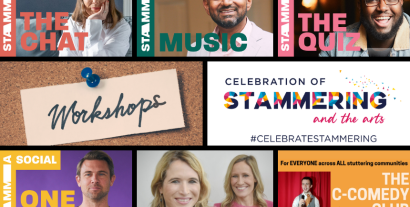
Both Paul and JJJJJerrome took part in 'A Celebration of Stammering & the Arts' in 2021. This online event connected artists, comedians, cartoonists, movie producers, documentary makers and more.
Flag
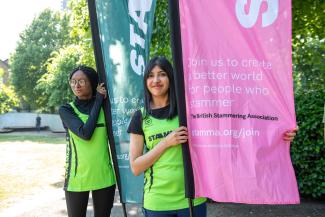
In 2022, the Stammering Pride flag was introduced to the world (see the picture at the top of the page). It was designed by Conor Foran in collaboration with a wider team of people who stammer. The flag features a wave pattern that symbolises the natural variation in stammering. Read more at stutteringprideflag.org
Criticism
The concept of stammering pride is one that splits the community. While some celebrate their difference, others struggle to do so. Some question if stammering is something to be 'proud' of, arguing that it's just something they do, it’s not good or bad, they just accept it and get on with it.
Some say that stammering pride denies the reality of life's difficulties with a stammer. That living with a stammer can be hard. In his article, Joshua St Pierre counters this by saying:
"While stammering pride does not erase the physical tension that often comes with stammering, it (somewhat ironically) makes stammering easier… When we stop trying to avoid and hide stammering, and, moreover, when we can recognise that so much of the tension comes from trying to meet society's expectations, speech can become more spontaneous and enjoyable."
Where does it leave speech & language Therapy?
The social model has sparked a wider debate on the role of speech & language therapy for people who stammer. Historically, therapy prioritised helping someone 'stop stammering' or be more fluent. Some argue that what may seem helpful can create feelings of shame, that it reinforces a stigma of stammering.
Some ask: is therapy teaching people that the way they speak should be corrected? If someone continues to stammer having had therapy, have they 'failed' in some way?
"People deserve a choice about whether or not they would like to reduce or remove their stutter. True choice can't exist when the imperative to 'treat' voices is taken for granted, and when our society continues to discriminate against stuttered speech..." (DidIStutter.org)
Understanding this has led to many therapists taking a more holistic approach, one which doesn't just consider how fluent someone is. But to also address their mental wellbeing and confidence to express themselves.
Speech & language therapist (SLT) Stephanie Burgess wrote an article for our site. In it, she says that therapists need to remember "it's not the stammer we're trying to fix or get rid of. It's the struggle, tension and negative baggage which can accompany it". Stephanie also highlights the importance of talking about acceptance as part of therapy. Not just with the person who stammers, but also those around them, eg parents and teachers.
The debate about balancing more traditional therapy techniques with acceptance goes on.
What is STAMMA's position?
We know that thanks to the growing Stammering Pride movement, more and more people feel comfortable stammering openly. If people can feel good about their stammer, then that's a great thing. We also know that it's not always easy to think like that. It can be a real physical struggle to talk. Not aways being able to express yourself in the way you want can be incredibly frustrating.
At STAMMA, we want to create a world that makes space for stammering. Our campaigns have centred around bringing a greater awareness and acceptance of stammered voices and celebrating the stammering community.
We also support people who want therapy for their speech. How someone sees and lives with their stammer is no one's business but theirs. We support SLTs and therapy training courses to learn more about the Social Model so they can provide a holistic approach.
What do STAMMA members say?
"People say they can see nothing in stammering to be proud about. I understand that. For me, the pride is in two things: first, refusing to be ashamed of any disfluency. Second, asserting the right of people who stammer to be treated fairly." (Jack)
"…sometimes I don't feel proud when I can't find the strength to be brave and speak out… Sometimes, I'd rather just be like everyone else. I'd rather just be able to say what I want to say". (Rebecca)
"I will always have my stammer, and I'm finally proud of it. It's made me who I am." (Russell)
"Maybe 'acknowledgement' is a more accurate term than being 'proud' of stammering? Even 'acceptance', i.e. 'this is me and I happen to have a stammer'." (Susan)
"Society will only be changed if it hears and sees stammering as acceptable. This is, first of all, a challenge that people who stammer must be brave enough to take up themselves… This approach may not work for everyone." (Tim)
What do you think?
Share your own opinions on Stammering Pride. Write an article for our Your Voice section — see Submit Something For The Site to find out how. Or why not start a discussion in our Facebook group?
Resources
- Stuttering Commons. A website from an international initiative aiming to "generate new understandings of stuttering". Its website features an online handbook and podcast "introducing people to Dysfluency Studies and exploring Stammering Pride, Fluency Privilege and Transformative Belonging". Read our volunteers' review of the Stuttering Commons Handbook.
- Stammering Pride & Prejudice: Difference not Defect. A book featuring a collection of pieces from people who stammer that challenge negative stereotypes. Edited by Patrick Campbell, Sam Simpson and Chris Constantino. Published by J&R Press Ltd.