Human connection: the essence of healing from speech anxiety
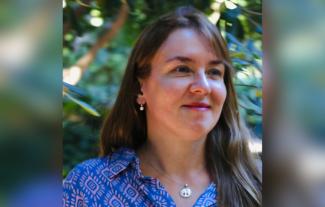
When Olga Bednarski wanted to find out why her anxiety about stammering fluctuated, she hadn't counted on it being down to something so fundamental, as she explains here.
Fifteen years ago, when I began my journey to freedom, I was searching for answers. I wanted to understand why my speech and anxiety fluctuated so much.
In some situations, and with certain people, I could speak freely — fluid, expressive, open. Yet with others, I would tense up completely. My jaw would tighten, my breath would vanish and my mind would fog over. I would tiptoe through conversations as if walking on eggshells, terrified of breaking something invisible. My voice would collapse into silence.
Afterward, I'd feel frustrated, ashamed and confused.
At the time, I didn't call it 'stammering'. That word wasn't even part of my vocabulary. I simply thought I was painfully shy. But even that didn't feel right — because deep down I was temperamental, expressive, even fiery at times. How could I be both shy and bold at once?
I would tiptoe through conversations as if walking on eggshells, terrified of breaking something invisible.
I convinced myself that if I could just become confident, my speech would 'straighten out'. So, I joined the McGuire Programme after hearing about it from people at the Liverpool Speakers Club — the first place I'd gone to beat my shyness'. The course was held in a hotel in Dundee, Scotland. On the first evening, I walked into a room full of strangers and was told to introduce myself.
Public speaking. Again.
My whole body froze. My breath was shallow, my mind blank. I filled my lungs with air but when I tried to say my name I hit a complete, silent block. My face turned crimson. People could see the effort, but no one could see how fragmented I felt inside — as if the connection between my thoughts and my voice had been cut off.
And yet, somehow, I survived.
Later, when I spoke to people one-on-one, my speech was suddenly free. I laughed. I shared stories. My anxiety subsided. I felt human again.
Over the next few days, we practised costal breathing and went out for 'contacts' — approaching strangers to speak, to face our fears. I remember my first one vividly. We went into a bar, and I had to tell the barman my name and explain what we were doing. My coach, Sid, stood beside me with quiet encouragement.
I tried to say my name. The first letter stuck. My head bobbed, my thoughts scattered and embarrassment flooded me like a slow wave. But I finished. I spoke. The ordeal was over.
Then the next contact. And the next.
By the tenth, twentieth, fortieth encounter, something incredible began to happen.
The fear dissolved.
My presence deepened.
My speech flowed.
I was no longer fighting for words — I was with them. Every conversation became an act of presence. I looked people softly in the eyes. I smiled. My body was relaxed and calm. My breathing was full. I wasn't trying to speak fluently; I was connected.
Over the years I've come to see this clearly: the essence of speech anxiety — and perhaps of most mental struggles — is disconnection.
That day, I felt something I couldn't name at the time — a return to myself.
I feel it wasn't the technique that set me free. It was the connection.
It was the countless small moments of human contact — no matter how fleeting they might have been — that made me feel safe enough to drop my guard. The breathing, the technique, the exposure, the repetition… they were all just doorways to something much deeper: a sense of belonging.
When I felt safe, I relaxed. When I relaxed, I connected. When I connected, I spoke.
It was that simple — and that profound.
Over the years I've come to see this clearly: the essence of speech anxiety — and perhaps of most mental struggles — is disconnection. Disconnection from our feelings, from ourselves, from our bodies, from other people, from life itself.
We learn to suppress, deny and resist our feelings to protect ourselves. But in doing so, we isolate ourselves — from the very connection that could make us whole.
The writer A.H. Almaas wrote:
"Liberation is really nothing but the personality becoming free in the moment. The personality loses its grip, lets itself just relax."
When we reconnect — with ourselves, with others, with the present moment — our nervous system calms. We feel safe. The tension unravels. The personality relaxes its grip.
And in that state, speech begins to flow again — naturally, effortlessly — because we are no longer speaking from fear, but from connection.
It is not the techniques that heal us, but the people who hold space for us. The ones we laugh with, cry with, stumble with. Human warmth, presence and shared experience — these are the real medicine.
We live in a world that celebrates independence, but healing happens in relationships. The more we reach out, the safer we feel. The more we allow ourselves to be seen, the more we return to our natural state of flow.
When we restore connection, we restore wholeness.
And that, I believe, is the true essence of healing — not just from speech anxiety, but from the deep loneliness of disconnection itself.
Because in the end, it's not about speaking perfectly.
It's about speaking connectedly.
It's about being here — present, open and human.
And that is where freedom begins.
Read more Your Voice articles. Would you like to share your story, thoughts or experiences? See how you can Submit Something For The Site or email editor@stamma.org
The McGuire Programme is one of a number of courses for people who stammer. Read more about the range of options on our Adult Stammering Courses pages and One-to-one Adult Speech & Language Therapy pages.
Related Links
Become a member
It's free
Join the movement to change how people understand and react to stammering.
Campaign. Fundraise. Connect. Meet. Vote. Talk.