Christmas film's patronising stammering portrayal
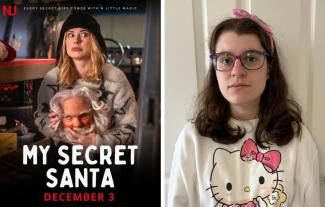
Isabella Moon tells us why one of Netflix's new Christmas films didn't exactly fill her with festive cheer.
Today, for the first time in my life, I saw a movie with a character who stammered but sadly I was very disheartened by the portrayal.
My Secret Santa is an American Christmas romcom which is the number 1 film on Netflix right now. It's about a woman who disguises herself as an older man so she can get a job as Santa at a ski resort. In one of the main scenes, a little girl who stammers comes to see Santa, and she is clearly nervous and shy. After saying her name, the girl tells Santa that for Christmas she would like to not stammer anymore.
My heart sank as I watched it. I have waited twenty three and a half years to see a person with a stammer on TV and when I do, the very first thing that person says, other than her name, is "I wish I didn't stammer". Wow. What an unsubtle message for us from society. Clearly, we're supposed to be ashamed of our stammers from very early childhood; be desperate to change it and pitied by everyone around us.
This little girl doesn't have any personality beyond stammering — she doesn't have any hobbies or toys that she would rather ask for because the impression given is that her stammer is making her too unconfident and stopping her from living a 'normal' childhood. As a child, I had a personality and interests and plenty of things to wish for for Christmas, like all the other children. Although stammering made my life more challenging at times, and I knew that, the idea of asking Santa or any other magical beings to cure my stammer never, ever entered my head.
Bad as all this is, the portrayal of stammering continues, every bit as patronisingly, as the scene goes on. When the girl shares her Christmas wish to not stammer, the woman disguised as Santa says, "Oh, I understand," a bit uncertainly and distantly. Then she tells the little girl that she's heard somewhere that singing helps with stammering, so why don't they (i.e. the little girl and the entire room full of people) try singing Jingle Bells together? The girl seems reluctant, not wanting to be the centre of attention, but after Santa and an elf sing the first line, she feels confident enough to join in. She stammers in the first line of the song, but is able to stop and sing 'normally' on the second. The crowd of strangers watching this are ecstatic, many of them filming such a 'special' moment on their phones, and the girl's mother is nearby looking suitably emotional as if a miracle has happened to her child.
Just because I stammer doesn't mean I want everything I do to be treated as an absolute miracle and a 'heartwarming moment' by those who don’t stammer.
Then, the crowd's videos of the girl singing with Santa go viral and reach a million views, with tons of likes and many positive comments praising how good the ski resort's Santa is with kids. As a result of people seeing this one incident, the resort immediately gets inundated with families wanting to stay there.
This all made me feel absolutely terrible. I'm upset by the fact that this girl being able to sing despite having a stammer suddenly became everyone's business, a miracle to make random strangers with zero experience or knowledge of stammering feel good about their lives, and a publicity stunt for the hotel to show they improved the life of somebody who was 'disadvantaged'. It felt so insulting to watch a large crowd (even in a movie) assume that because we stammerers struggle with one area of life (talking), we therefore need help from 'superior' non-stammerers even with other unrelated areas of life.
I stammer when I talk but I can sing, I can read, I can write, I can walk and run, I can create art, I can use technology independently. I can do lots of things unrelated to stammering that most of the general population can do. Just because I stammer doesn't mean I want everything I do to be treated as an absolute miracle and a 'heartwarming moment' by those who don't stammer.
Plus, as I'm sure you're already well aware, singing doesn't 'cure' stammering anyway. I feel so sad that the fact that stammerers can sing without stammering (because talking and singing use different parts of the brain) has been taken and twisted by non-stammerers into this stupid urban myth that one can easily cure the other. That it's a 'transferable skill' that you can just transfer to talking; that non-stammerers get to go around harassing us with unhelpful and unwanted comments, genuinely thinking they're being so heroic and clever when they say, "Oh, have you tried singing?" It was very hurtful for me to see singing being portrayed in the movie as so clever and successful when in real life, I have had very patronising experiences of ignorant people trying to force me to sing when I don't want to because they're so sure it'll be 'miraculous' for my speech.
As STAMMA has been strongly advocating for people with stammers to be properly represented in films and TV, I felt compelled to share my experience and to let people know about the movie in case it may be triggering for them.
Would you like to write an article? See Submit Something For The Site or email editor@stamma.org for details.
Related Links


Become a member
It's free
Join the movement to change how people understand and react to stammering.
Campaign. Fundraise. Connect. Meet. Vote. Talk.