Sharing Scatman John's story with the world
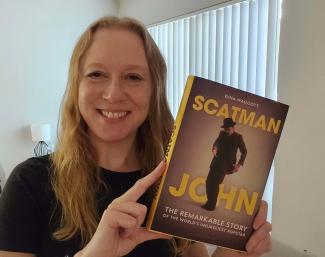
With her biography of Scatman John in bookshops now, author Gina Waggott tells us why she wanted to tell the story of the unlikely popstar who made space for stammering.
In 1995, a 52-year-old jazz pianist with a stammer became one of the world's biggest popstars.
John Larkin — better known as the fedora-wearing, moustachioed Scatman John — turned his stammer into scat-singing and gave us earworms such as Scatman (Ski-Ba-Bop-Ba-Dop-Bop) and Scatman's World, both of which topped charts in dozens of countries. By the end of that year, he was Europe's biggest-selling male star, ahead of Michael Jackson. Yet what is often remembered as a novelty was something far more radical: a man openly stammering on global stages and telling children, "If the Scatman can do it, so can you".

I was one of those children. Nearly three decades later, I've written his authorised biography.
Befriending John
It feels surreal, because this book is deeply personal. It is not hyperbole to say that John saved my life. In the 90s, I was a struggling, isolated teenager, hiding my stammer and feeling deeply ashamed of it. I wrote to him in despair and, to my amazement, he wrote back. We became friends. One of the first things he did was encourage me to join STAMMA (then the British Stammering Association). He helped me begin to face my covert stammer head-on and offered me a level of compassion and validation I had never experienced.
Back then, when stammering was widely treated as something to hide, fix or cure, he stood up and openly stammered, without apology, on TV, on the radio, and on stage. That may be John's legacy as much as any hit single: he made space for stammering in public. A celebrity stammerer who overtly stammered. It was rare then. It's still rare now.
It feels surreal, because this book is deeply personal. It is not hyperbole to say that John saved my life.
John died in 1999, but I stayed in touch with his wife, Judy, and I ran the Scatman website for years. When Judy died in 2023, it was a trigger — I knew if I waited much longer, the people who knew John would be gone. I decided I would write his biography. But there was a catch.
Coming out of hiding to tell John's story
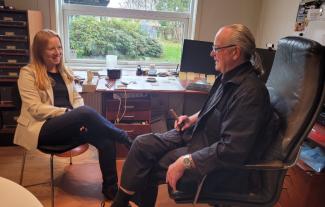
I have spent much of my life hiding my stammer. Yet this book forced my hand. To do John justice, I had to reach out to more than 100 people from every stage of John's life. I had to do exactly the things I had spent years avoiding: make phone calls, arrange interviews, speak to strangers, ask difficult follow-up questions, and let myself stammer while doing so. Otherwise, how could I possibly explain John's impact on me?
My stammer has never been particularly obvious to others, but my feelings about it have been negative and self-sabotaging. The fear, the anticipation, the constant self-editing, the urge to dodge words, phones, introductions, opportunities… the temptation to hide is always there. But this time I didn't, because I kept thinking of something John once said: hiding your true self is like trying to hold a beach ball underwater. You can do it for a while. But eventually, it rises.
I knew then — it had to be me. This wasn't a biographer choosing her subject, but a torch being passed.
This became especially true when I found a preface to John's unfinished autobiography. He described it as “a book about the life of a stutterer, written by a stutterer, for a world largely uninformed on the subject”. He believed a reader should feel what it is like to stammer, and only a person who stammered could write that kind of book. I knew then — it had to be me. This wasn't a biographer choosing her subject, but a torch being passed.
I was often overwhelmed, not by the writing but by the emotional weight of the material, and wanting to get it right. John's story is extraordinary, but it is also a story of trauma, abuse, addiction, shame, reinvention and grace. I felt a responsibility to him and to the people who loved him, to be true to him, and not flatten him into a saint or sanitise the darker parts of his life.
Speaking out on the publicity trail
In the run-up to publication, I was thrown into speaking situations I had long dreaded — but I faced them, not just for myself, not just for the book, but for John. I've done multiple podcasts, recordings and live on-air interviews with RTE, the BBC and Talk Radio Europe, to hundreds of thousands of listeners. Earlier in my life, I might have treated those appearances as a test of concealment: how fluent can I sound? What can I get away with? This time, I decided otherwise. If I stammered, I stammered. After all, if it's live, they can't stop me. It was unbelievably freeing.

Most interviewers gave me space, listened, and — at my request — did not edit out my stammering. Some old myths surfaced (for example, that stammering is caused by trauma), and I was proud to challenge them in real time. But what struck me most was how much easier and less stressful communication became when I stopped spending so much energy trying to hide the way I talk.
That was a revelation to me, and an unexpected gift of the whole process. I have John to thank for that, too. All these years later, he encouraged me to speak out again.
Now, Scatman John: The Remarkable Story of the World's Unlikeliest Popstar has just been released: a book about a stammerer, written by a stammerer, published by a major publishing house. That should not be remarkable in 2026. And yet it still is.
I am delighted, of course, that it puts stammering out there — not as something to 'overcome', but simply as stammering; the way some people speak, that has long been misunderstood. But more than that, I want readers, especially people who stammer, to meet Scatman John properly: not as a meme or a retro novelty act, but as John Larkin — a musician, a survivor, a mentor, and a wonderful human being, who turned shame into connection, trauma into joy, and made it easier for the rest of us, including me, to be heard.
Scatman John: The Remarkable Story of the World's Unlikeliest Popstar, published by Bloomsbury, is out now to buy on all formats. We'll be reviewing it very soon.
Read more Your Voice articles.
Would you like to write an article? See Submit Something For The Site or email editor@stamma.org for details.
Related Links


Become a member
It's free
Join the movement to change how people understand and react to stammering.
Campaign. Fundraise. Connect. Meet. Vote. Talk.