The myth of fluency

Bill McMillan muses on the notion that fluent speech equals perfection, and questions whether 'fluent' speakers are as fluent as we think.
This article should be subtitled 'or how a woman's advice many years ago was dredged up from my memory by a hearing aid'. Maybe that's a bit long, but I will explain.
On STAMMA's website, there's a page called If you don't stammer read this which has a section entitled 'Fluency is King'. This goes into detail about how job advertisements that say "applicants must have excellent communication skills" can put people who stammer off from applying. I have often wondered how this phrase, which really means very little, came into being.
When I was working, the people I knew who were considered good communicators were the ones who 'talked the talk' and spent most working days in meetings so they could hear the sound of their own voice, in an environment where the ability to tell jokes was highly regarded. Not bad people, just ambitious; people who knew how to project themselves in a favourable light.
I suspect that nowadays, fluency has come to mean silky sounds, which bears no relation to everyday speech.
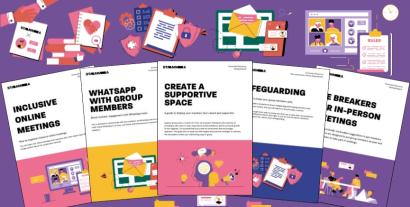
I recently reviewed a new handbook on the Stuttering Commons website for STAMMA, a resource that aims to challenge perceptions of stammering. Reviewing it was a pleasure; it is a very well written resource which deals in no uncertain way with the myth of fluency. This, together with STAMMA's page and my hearing aid (more about that later), has opened my eyes — and ears — so much that it dredged up an old memory.
I started stammering when I was about six or eight. It happened around the time I contracted rheumatic fever, so my mother always claimed (with no medical knowledge at all, just motherly instinct) that that was the reason it started. I remember one of my teachers was very kind to me (sadly the only one, as there wasn't much understanding about in these days). She said that people who don't stammer often have breaks in their speech; they can repeat themselves, don't always finish their sentences, and sometimes give hand movements as if to say 'you know'. She said the difference between stammering and 'ordinary speech' was not too great. I wish I could remember her name, she was certainly ahead of her time, I think.
Her comments came back to me when I had to start using a hearing aid and realised that unless I put the TV sound up to the highest decibel, which would surely make me very unpopular with my neighbours, I couldn't hear it properly. So I discovered subtitles, which are great, but it kind of confirmed how non–fluency is often tolerated as fluency. Reading the subtitles proved that my kind teacher was spot on and it took all of the above to show me she was right.
Try turning on a TV debate... and it's astonishing how all the fluent speakers have their ums and errs shown on the subtitles.
I suspect that nowadays, fluency has come to mean silky sounds, which bears no relation to everyday speech. People don't talk like Shakespearean actors. Next time you go on public transport or are in the pub or at family gatherings, sit quietly and listen. There are lots of 'ums' and 'errs', plus repetitions. A lot of it is poor vocabulary, but not always. Try turning on a TV debate or something that demands unscripted fast thinking, and it's astonishing how all the fluent speakers have their ums and errs shown on the subtitles. Are our ears (or in my case ear) attuned by custom?
There is nothing better than an actor or a politician declaiming in a rich, powerful voice. However, it must be said that this is an illusion. Catch them off script, listen to the gaps, rambles and nonsense they spout. To me, politics aside, it appears that the politicians of 40 years or so ago were much more knowledgeable and certainly very smart at thinking on their feet compared to today. Possibly because there were no 'soundbites' then. People appreciated straightforward facts and figures then with not a thought given to style. Think of two brilliant orators, Winston Churchill and Aneurin Bevin. Although both had stammers, the words coming out were first class. This is probably a stretch too far, but expecting people to sound like Ronald Reagan is just paying lip service to the illusion. But I am convinced this is a factor in how people who stammer are viewed by employers, etc.
I was a great fan of Marshall McLuhan, the Canadian Philosopher. He wrote that "The medium is the message," arguing that the way the media presents information has a greater impact than the content it carries; it shapes ideas and how people think.
Maybe it sounds daft, but just think how impressed people are by smooth-talking, well-groomed demi-gods with their hypnotic oratory. The world is not a smooth, fluent place and the hidden influential environment created by the media can, I feel, not be ruled out as something to blame for this.
In conclusion, if you're anxious about your stammer, I'd suggest watching live, unscripted TV programmes with the subtitles on. It might just make you feel better.
Read more Your Voice articles.
Would you like to write an article? See Submit Something For The Site or email editor@stamma.org for details.
Related Links


Become a member
It's free
Join the movement to change how people understand and react to stammering.
Campaign. Fundraise. Connect. Meet. Vote. Talk.