Book review: My Voice, My Story
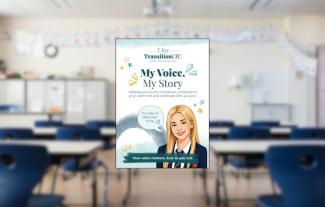
Amira Moghal from the STAMMA Youth Panel shares her thoughts on My Voice, My Story: A Stammering Workbook for Children and Young People by 16-year-old Millie and her mother.
My Voice, My Story is a workbook written by Millie, a teenager who stammers, and her mother. The booklet aims to help young people who stammer feel understood and empowered by modelling how to reframe negative stammering experiences. It also outlines how stammering can fit into a joyful and fulfilling life.
Sixteen-year-old Millie is the narrator of the booklet, and her reflections complement the writing and drawing exercises. This helps the reader to bridge the gap between the abstract advice and examples of how to deal with the day-to-day difficulties of living with a stammer, and putting these things into practice. The final three pages of the workbook provide lots of space to map out and explore what this means for the young person working through the booklet.
The narrator's voice is kind, thoughtful, compassionate and reassuring; she almost feels like an older sister. Towards the end of the booklet, Millie addresses a letter to her eleven-year-old self, which is something I wish I could have read when I started secondary school. At eleven, sixteen-year-olds seem unimaginably cool and self-possessed, shooting stars on their way into a bright and beaming adulthood. And so, to read a letter saying that everything will be okay, from someone who was a stammerer at both eleven and sixteen, would have really benefitted me.
This strength and understanding permeates throughout the workbook, as the narrator offers little kernels of wisdom relating to things that stammerers tend to struggle with: school, friendships, self-disclosure, asking for help, dealing with the feelings stammering brings up, the inconsistency of stammering, and holding space for the good and bad.
I think that young people who stammer will find the workbook incredibly useful while they are figuring out how to navigate their turbulent teenage years and their time at schoo
Millie reassures the reader that "you don't have to be the loudest person in the room for your voice to matter". This is a helpful rebuttal to the dominance of the loud, confident students who tend to overpower a classroom, and to the more general introduction to social hierarchies that we get at school.
This allows for a more expansive view of identity, which puts less emphasis on how other people might perceive your stammer. Millie writes, "your classmates might remember your kindness, your smile or your sense of humour — not the moments when your words got stuck".
This helps to chart the way for a better relationship with how stammering can make you feel. At the bottom of each exercise page, there is a small section titled, 'Today my voice feels…' This takes into account the variations in how much someone stammers day-to-day, week-to-week, or month-to-month. And the focus on how 'my voice feels,' makes space for an important distinction between how your voice feels when you're considering other people's reactions, and how your voice feels in the moment of stammering. Young people who stammer have to come to terms with this vast emotional landscape quite early on, and this exercise can help with that.
The workbook includes imaginative exercises, which include drawing your stammer, imagining a worry monster, and imagining a worry thermometer. This validates difficult feelings, and makes space for how overpowering and frightening they can be. I attended a 'Draw your stammer' workshop at STAMMAFest 2026 this August, and the children at the workshop revelled in the chance to safely explore these feelings through play.
I think that young people who stammer will find the workbook incredibly useful while they are figuring out how to navigate their turbulent teenage years and their time at school, with the question 'who am I?' crossing their minds for the first time.
The lifelong quest to get to know yourself better can be complicated by stammering. This workbook can help young people who stammer at the start of this meandering journey, as it explains that it won't always be easy, but that with support they can keep talking, keep asking for help, keep sitting with how they feel, and keep being themselves.
My Voice, My Story: A Stammering Workbook for Children and Young People is a self-published digital workbook by Millie and her mother Kirsty, available to buy from tfortransition.co.uk.
Co-author Kirsty has written an article all about her daughter and the story behind the book. Read 'From our family to yours'.
Thank you very much to Amira for reviewing this workbook for STAMMA.
More
Related Links

Become a member
It's free
Join the movement to change how people understand and react to stammering.
Campaign. Fundraise. Connect. Meet. Vote. Talk.