Sam Neill & his journey with stammering
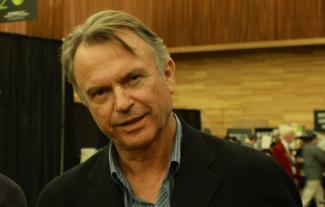
Sam Neill, the actor famous for his roles in The Piano, Jurassic Park and many others, has sadly died at the age of 78. Sam was a supporter of our charity and was open about his journey with stammering with the media. Here's a look back at Sam Neill's life, and what he's said about living with a stammer.
Sam Neill was born Nigel John Dermot Neill in 1947 in County Tyrone, Northern Ireland, but relocated to his father's native New Zealand when he was seven. At school, Sam started using a new name to avoid any confusion between him and his best friend, who was also called Nigel.
As a child, Sam developed a stammer which affected his confidence so much that he hardly spoke for 14 years: "I spent most of my childhood hoping that people wouldn't talk to me so that I didn't have to talk back," he told the Australian TV programme Enough Rope.
Things started to shift when his parents enrolled Sam on an activity course, he told us in an interview for our old magazine Speaking Out:
"I was sent on one of those, kind of, outward bound things where you had to run across logs or fall in the river and drown, and that did a lot for my physical self-confidence."
But it was the discovery of acting whilst at school where things really started to change, he said in an interview with Gourmet Traveller:
"I also had (and still have) an older brother who was much brighter than me, and always arrived home with glowing reports. Mine were invariably dismal, but I found I could act a bit. And when on stage, I didn't stammer at all. I loved the sensation of being able to say words with clarity and conviction. And for a boy with little scholastic or sporting skills, a moment of attention – however small – was quite a thing."
He elaborated on this and its effect on his speech, in his interview with us:
"I was learning to debate, and I was involved in drama and plays and so on. I was becoming kind of a confident person, and I suspect that all of that kind of worked on the stuttering and vice versa, and so there was no particular game plan, it just sort of happened organically."
Sam's love of acting deepened when he joined the Drama Society at the University of Canterbury in New Zealand, where he was studying English literature.
"I realised on stage I could speak clearly and that gave me the courage to talk to people and talk to adults." (WTF with Marc Maron podcast via Female First)
"Acting has had a therapeutic effect on me and it probably helped give me confidence." (Stuttering Foundation)
After leaving university, Sam started work at the National Film Unit as a Production Trainee in 1972, before landing his first acting role in Landfall – A Film About Ourselves. He then went on to star in New Zealand's first colour feature film Sleeping Dogs in 1977, which got him noticed internationally:
"Someone saw me in that film and asked me to come to Australia and act in a film called 'My Brilliant Career' opposite Judy Davis. For the first time in my life, people said, 'You're actually quite good.' Then I started making a good living as an actor and that took me to England and points beyond." (WTF with Marc Maron podcast via Female First)
While in the UK for filming, Sam became a supporter of our charity, back when it was called the British Stammering Association, and was featured in our old magazine Speaking Out. He went on to conquer Hollywood, appearing in films like The Omen III and Dead Calm, and of course the smash-hit Jurassic Park in 1993, where he played palaeontologist Dr Alan Grant.
Sam's daughter Elena developed a stammer too, and as a result of his own experiences as a child, he sought speech & language therapy to help her. Confirming to him that stammering was in part hereditary, this led to his criticism of the Oscar-winning film The King's Speech:
"I have to say, as much as I liked the film, I did take issue with it. In the movie George VI had been bullied by his father and his stutter was the result of that, but the idea that a stutter is caused by childhood trauma has been rather discredited. It's more like a genetic disposition." (Stuttering Foundation)
Sam will be remembered for his extensive screen career spanning Hollywood blockbusters and acclaimed arthouse movies, including A Cry in the Dark, Dead Calm, Sirens, The Dish, Event Horizon and more recently Peaky Blinders. In the 1980s, he was even in the running to become James Bond (watch his screen test) before losing out to Timothy Dalton.
Despite the world knowing him for fluent-speaking roles, Sam was open about the fact that he stammered: "You can still detect me as a stammerer," he told Enough Rope. Chief presenter of BBC News, Lucy Hockings, recalls an interview she did with Sam at the London premiere of Hunt for the Wilderpeople in 2016:
"We spoke about home and I asked him if he'd come into the studio for an interview. He hesitated. 'Live television makes me nervous', he told me, 'because of my stutter'. He came anyway and was generous, funny and without affectation. What struck me was how little interest he seemed to have in celebrity. He said he wasn't a Hollywood star, just a New Zealand actor who worked there from time to time."
Although occasionally struggling with his speech, in his interview with us Sam reflected on the positives that stammering gave him:
"The upside of that was I probably learned to listen better than most of my contemporaries… I’m still fairly economic with words and I think that's a good thing."
Alongside filmmaking, Sam's other passion was in wine-making and he owned several vineyards in New Zealand.
In 2022, Sam was diagnosed with non-Hodgkin lymphoma, a type of blood cancer, in 2022, and because of this decided to finally accept a knighthood in 2023 after having been offered numerous times before and refusing. He announced in April of this year that he was cancer-free. But died on pneumonia on 13th July 2026.
Here at STAMMA, our thoughts are with Sam's family at this difficult time. We're so grateful to him for supporting our charity over the years, particularly in the 1990s, for speaking to the world about stammering and showing children who stammer that they can follow their dreams.
Sam Neill (1947-2026)
Related Links

Become a member
It's free
Join the movement to change how people understand and react to stammering.
Campaign. Fundraise. Connect. Meet. Vote. Talk.
Your Voice