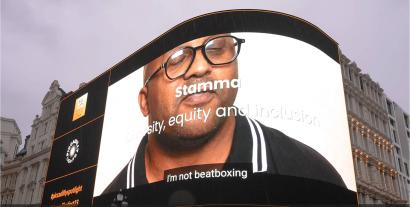
Finding my voice — one word at a time

Relationship teacher Sam O. Opeche explains how his journey with stammering led him to write a book about learning to communicate more effectively.
I used to sit at the back of the classroom, not because I couldn't see the board, but because I didn't want to be seen.
If you stammer, you might recognise that feeling. For me, school wasn't just about learning — it was about managing the fear of being asked to speak. No one except me knew how reading out loud or answering a question quickly could turn into a moment of embarrassment. So, to avoid being embarrassed, I chose to hide in the shadows of my classmates who sat before me.
I still remember the laughter from classmates and at times even the impatience of teachers when I couldn't get my words out at the pace they'd expected. It chipped away at my confidence more than I realised at the time. That's why I did what many people would do in that situation: I withdrew. I stayed quiet. I chose the back of the room, where I felt safer.
Invariably, speaking wasn't something I enjoyed; it was something I tried to avoid.
The gamechanger
But things began to change thanks to a teacher who saw something in me that I didn't yet see in myself. My music teacher, Mrs Akin, gave me advice that was simple but life-changing: "Slow down," she said.
Teaching me to resist the urge to rush my words, she coached me to instead focus on controlling my breathing. That alone began to shift things. But she didn't stop there. She encouraged me to listen — really listen — to how people spoke. This was a game-changer for me.
I began to realise that speaking wasn't just about getting words out, it was about how those words were delivered.
Although we didn't have podcasts back then, I would listen to the news and cassette recordings. I'd pay attention to the pace, the tone and the clarity. And then I'd practise. I'd mimic what I heard, repeating it in my own time, in my own space.
This might sound insignificant to most people, but not to me. As a process, it was a big deal for me, truly my turning point.
Over time, I began to realise that speaking wasn't just about getting words out, it was about how those words were delivered. Slowing down gave me space. Breathing gave me control. And listening gave me a model.
In fact, you may not believe this, but I enjoyed it so much that I seriously considered becoming a broadcaster at one point.
Even now, people often say that I speak calmly or that I choose my words carefully. What they don't always realise is that this came from speech adversity. I had to learn how to respect my words — and in doing so, I found my voice.
My book
That journey has shaped so much of what I do today.
I now work as a relationship teacher and mentor, supporting individuals, couples and families. I also work with young people and families in the community, including through my work with Castle Point Volunteering Service and Essex Police. Across all of these spaces, one thing keeps showing up: communication matters.
Not just what we say, but how we say it.
In relationships, especially, I've seen how words can either build connection or create distance. And often, it's not because people don't care — it's because they don't always have the language to express what they feel in a way that can be heard and understood.
Take your time. Find your rhythm. And trust that your voice — in your own way — has value.
That's what led me to write my book, The 6 Emotionally Intelligent Languages for Couples. It's all about helping people communicate more effectively, learning how to express appreciation, show empathy, repair after conflict and build deeper connections through intentional words.
In many ways, I don't think I would have written this book if I hadn't gone through my own journey with speech.
Learning to slow down taught me that words carry weight. Learning to listen taught me that communication is a skill. And learning to persist taught me that growth is possible, even when it doesn't feel easy. And even when it still feels like my words come out slower than those of most people, I draw strength from knowing that because they are coupled with thoughtfulness and care, they land well.
Hence, if I could say anything to someone currently navigating a stammer, it would be this: your voice still matters. You don't have to rush it. You don't have to force it. And you certainly don't have to compare it. Take your time. Find your rhythm. And trust that your voice — in your own way — has value.
Because sometimes, the very thing that feels like a limitation becomes the foundation of your purpose.
If you're interested in my work on communication and relationships, you can find more on my 'Words That Heal' series on social media or in my book, The 6 Emotionally Intelligent Languages for Couples.
Read more Your Voice articles.
Would you like to write an article? See Submit Something For The Site or email editor@stamma.org for details.
Help to keep these stories going
Articles like Sam's help people who stammer feel less alone. They inspire and encourage others.
Donate today and help us share more voices.
Related Links


Become a member
It's free
Join the movement to change how people understand and react to stammering.
Campaign. Fundraise. Connect. Meet. Vote. Talk.