Why I took my stammering group outdoors
Speech & language therapist Jaclyn Morton tells us about moving her therapy group out of the clinic and into the woods, and the effect it's having on the children and their parents.
When we think of speech and language therapy, we usually picture a quiet clinic room or a small table in a school corridor. While working in these spaces can be helpful, I often found myself wondering whether we are giving young people the chance to actually live out what we talk about in therapy.
We talk so much about building confidence, being open and embracing who we are. But learning those skills inside a room is one thing. Transferring them to the real world is another.
That's why I decided to take therapy outside.
A space to just be
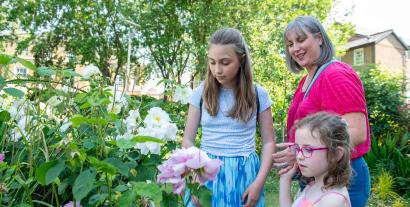
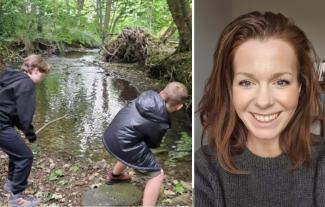
Every Monday evening for the past ten weeks, a group of children who stammer aged 7 to 12 have been meeting at a local allotment which sits next to a patch of beautiful woodland. The site is run by Sol, a teacher who uses the land to support all kinds of community groups.
It's an incredible space. There is a growing area for vegetables, a woodwork and building zone, and a covered outdoor kitchen with a gate leading to the woodland. We do crafts, feed the hens and play pool and then escape to the woodland where there is no pressure on talking, no questions to answer and things just feel free.
Being outside completely changes the dynamic.
Being outside completely changes the dynamic. Sitting across a desk in a school environment can sometimes carry an implicit pressure. Outdoors, it seems that pressure doesn't exist. The children seem comfortable and confident. They chat openly about stammering and there is often a constant murmur of chat and laughter. Different environments bring out different strengths, and the allotment offers a space where nobody needs to sit still and nature kind of does my job for me!
We have a dedicated 'stammer space' where we talk about talking, but so many of our communication goals are met organically within the activities we do. This is because we want stammering to be interwoven into who they are — a part of their identity, rather than something that needs fixing or something they are defined by. It's a space where they can communicate openly, stammering or not. We make space for stammering and take time for children to share ideas so their voice is always heard.
Just the other week, one boy told his friend he couldn't understand what he was saying because he was talking too fast. The other boy simply responded, "Yeah, I do that sometimes. If I slow it down a bit it helps, doesn't it?" There was no speech therapist in the mix and no adult telling him to slow down to stop stammering — just a friend supporting a friend so he could understand which part of Pokémon he was talking about.
Bridging the gap for families
In traditional settings, parents and children are often worked with separately. Parents frequently tell me they aren't quite sure what happens in therapy, and why. More than that, they rarely get the chance to watch their children make friends and communicate with others outside the home.
The allotment changes that, too.
While the kids are busy, a supportive community has grown naturally among the parents. We have a no-phone zone which helps us to stay present. I spend time with the parents who share stories, share what's helping and generally just know they're not alone in this. The naturalness of the setting again supports this. It feels relaxing and easy, like we've all known each other a long time.
Our aims: confidence, connection & camaraderie
Our goals for the group are:
- To build a stammering community: Meeting other children who stammer so no one feels isolated.
- To practise openness naturally: Creating a space where stammering is simply part of the conversation through real, everyday interactions.
- To connect with nature and ourselves: Learning new skills, having fun and figuring out what makes us feel strong from the inside out.
In a few years, I'd love to explore whether this group's positive, outdoor atmosphere translates into a lasting positive association with their stammering. My hope is that connecting with friends early on, in a space where they can be fully themselves, instills a lasting sense of confidence.
Read more Your Voice articles.
Would you like to write an article? See Submit Something For The Site or email editor@stamma.org for details.
More
Related Links


Become a member
It's free
Join the movement to change how people understand and react to stammering.
Campaign. Fundraise. Connect. Meet. Vote. Talk.