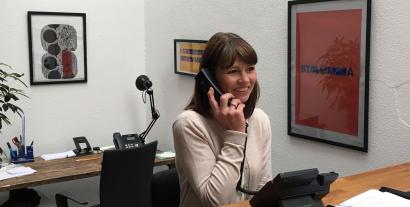
I can finally say: I have a stammer

GP Tasneem Khan tells us about life with an undercover stammer, what helped move her beyond it, and what she says to parents of stammering children looking for help.
I have a stammer.
I block, I pause, I repeat, I stumble and very often I give up what I want to say. But after decades of hiding, compensating and apologising, I can finally say: I have a stammer.
I spent most of my life as an undercover stammerer. I recognised early on that I was getting stuck on words, so I started a word-finding covert operation. Every sentence was scanned before I spoke, and any potential enemy words were substituted with precision. This became habitual, a reflex. And it worked really well, until someone asked me my name. When ordering a drink at Starbucks I would always give someone else's name (it is harder to say the T in Tasneem). I felt like a fraud, but it got the job done. Drinks orders were always "orange juice" — my palate adjusted to like the foods I could pronounce. Never did like pppppepperoni pppppizza anyway.
I was congratulated on my fluency. This reinforced the notion that my stammer was a dirty little secret and it must stay hidden at all costs. When I stammered I was told to relax, to slow down. Being told to relax is a sure way to get the autonomic nervous system firing. Slowing down didn't help. It just took me longer to get stuck.
Learning to let myself stammer
I had speech therapy in my teens. I remember being told "maybe being a doctor isn't the right job for you because you will have to use the phone a lot". I chose to ignore that advice.
I had more speech therapy at university. I was always fluent in my group therapy sessions, much to my dismay. It felt like this was the stammer once again plotting to make me seem like an imposter.
I was congratulated on my fluency. This reinforced the notion that my stammer was a dirty little secret and it must stay hidden at all costs.
I attended courses where we learnt breath control to ease the sounds out through the larynx. I wore specialised belts around my waist to assist diaphragmatic breathing. And all of this worked temporarily. But it was hard work. It was exhausting. And it all fed into the notion that stammering is bad, it needs to be hidden, it needs to be fixed.
I finally discovered a stammer-affirming model of speech therapy after reading a research article called 'Reimagining stuttering therapy and outcomes through an acceptance and collaborative lens'1. It's pretty simple — stop hiding it. Let yourself stammer. No more word-finding, no more situational avoidance, no fancy breathing techniques. Just, talk.
Now this was not easy. I started informing people that I stammer and apologising for the extra few minutes that they would require to listen to what I would have to say.
Medical school & beyond
In medical school I was asked how much extra time I needed — well, I didn't know. Would the extra time actually help me get my words out? Or would I end up being extremely fluent and appear to be a fraud (again).
I never felt I could tick the 'I have a disability' box. I was prevented from doing a lot of things because of stammering and it had a profound impact on my life, but I wasn't looking for a blue badge to compensate. Turns out that stammering can be considered as a disability under the UK's Equality Act 2010. But even in the Royal College membership examinations, there was confusion about what reasonable adjustments I would require. In the end I had none.
I still have days where I come out of my clinic into the waiting room and turn back around because the patient's name is stuck in my throat and I need a minute to compose myself.
Six years at medical school, twelve years as a junior doctor, and three years as GP. The medical school curriculum, postgraduate training, the Royal College examinations, the continuous professional development — none of this has EVER mentioned stammering. Surely a condition this prevalent, with such a huge impact on quality of life, deserves a footnote at least.
Parents & patients who stammer
As a doctor, when you are faced with someone who stammers, what do you do? Give them time, eye contact and space. But what about the well-meaning parent who asks for a speech therapy referral for her child, who tells you "I keep telling him to slow down and not be nervous". You do the referral, but what do you say to her?
You tell her that it's not always helpful to think of speech therapy as a 'fix' for the stammer; it needs to be about empowering a child to communicate more confidently, stammer or not. You gently suggest that they try not to instruct the child on how to speak, as this can feed into their anxiety surrounding dysfluency. You suggest not telling their child to relax, as that is often not helpful. And you look at the child and tell them — you are not alone.
I've stopped apologising.
I am now a mother of a child who stammers (yes, it can be inherited in some non-Mendelian fashion — as if there wasn't enough guilt to deal with). I want to empower my son to stammer openly. I am honest about the frustrations, the unpredictability, that feeling that your own voice betrays you. I still have days where I come out of my clinic into the waiting room and turn back around because the patient's name is stuck in my throat and I need a minute to compose myself. But that's my journey. I don't choose to stammer. I have a stammer. And I will speak.
Tasneem Khan is a GP and a primary care researcher at the University of Leeds. Her Instagram handle is @dr.tasneem.khan
Read more Your Voice articles.
Would you like to write an article? See Submit Something For The Site or email editor@stamma.org for details.
References
1 Irani F, Azios M, Boyle M, Coalson GA, Palasik S, Rodriguez J, et al. Reimagining stuttering therapy and outcomes through an acceptance and collaborative lens. J Fluency Disord. 2025;83:106105.
Help to keep these stories going
Articles like Tasneem's help people who stammer feel less alone. They inspire and encourage others.
Please donate today and help us share more voices.
Related Links


Become a member
It's free
Join the movement to change how people understand and react to stammering.
Campaign. Fundraise. Connect. Meet. Vote. Talk.
Your Voice