"I was put through to a voice-activated automated menu immediately, so no opportunity to say I stammered. This resulted in me repeating a 14-digit tracking number literally about 10 times as the automated service could not understand it due to my stammer. The more times I had to repeat, the more frustrated and anxious I became. I ended up in tears with the frustration I felt."
Making Calls Accessible
This page is for you if you take calls from the public — regardless of the size of your organisation.
Our research
In Sept 2025, STAMMA surveyed hundreds of people who stammer, asking them about their most recent call to a business or organisation. The topline takeaway was that 98% said calling a business was hard.
At least 550,000 adults in the UK stammer. According to Contact Babel, this equates to more than 43.5 million calls every year — even considering a reluctance to make calls. Millions more people experience other speech disabilities such as dysarthria, aphasia, dyspraxia and ataxia, or voice difficulties at some point, and will face similar challenges with telephony systems.
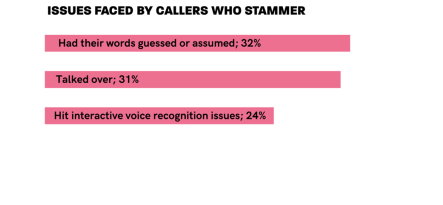
(Source: STAMMA members survey, 2025)
Our findings
Most dread using the phone and expect to be cut off. And many were. Some were laughed at. Some had their stammering misinterpreted as nervousness. Some got stuck in voice response systems that didn't give them enough time to talk. Others just gave up trying.
"I block when I stammer, so people I call think I'm at the end of my sentence when I'm struggling to get my next word out."
"I struggle with my name as I cannot navigate around it… I felt she thought I was stupid."
Many people who stammer do want to talk to you on the phone. It's often the most effective way to sort out an issue or resolve a query. So, how do you tell if it's a bad phone signal or someone getting stuck on their words? Follow the tips below.

Sign up to one of our free workshops
Our free online, 1-hour session fully equips your frontline agents with the immediate skills and confidence to handle calls from people who stammer. Book your sessions now.

For organisations looking to upgrade their processes, QA frameworks and management policies, we offer in-depth consultancy packages and bespoke sessions.
Three key areas
To give you an idea of what we've found and how to deal with calls, here are three key areas that can cause difficulties and tips for dealing with them.
- How you respond at the start of calls.
- How you take callers through ID procedures.
- How your technology supports callers or creates barriers.
The start of calls
It's common for people who stammer to find they can't speak immediately when calls begin. They may experience a 'block', where no sound comes out of their mouth for several seconds or longer. Or you might hear sounds but not words as they're trying to speak.
It can be easy to assume that it's a bad line and then repeatedly ask if callers are there or hang up on them. This can be frustrating and humiliating for your caller.
Our 'Silence on the line' guide
Download our guide to see two suggested scripts for dealing with silence at the start of calls, or situations where you think there may be a bad line. These approaches create space for callers who stammer to speak, and a more supportive way to end calls when necessary.

ID processes
It's common for people who stammer to stammer on their own name or when saying key details. These are all words that can't be changed or said in a different way that's easier for people. Which means that ID procedures can be fundamentally difficult for people who stammer.
Don't assume that someone is nervous, unsure or fraudulent if they're having difficulty saying their name or account number. And don't say, "Did you forget your name?". That's not helpful.
Allow the caller the time they need to get their words out. Some people who stammer may choose to spell their name for you. That's OK.
If your system allows for information to be given verbally or by pressing keys on the number pad, offer all callers the option to choose between either of those channels.
Remember, it's normal for people who stammer to find those key words difficult to say. Give us time.
Technology
Look at customer record flagging, IVR and fraud detection.
Customer record flagging
Offer all of your customers the option to flag if they have extra needs when using the phone. Some customers may then choose to let you know that they stammer and request that it's added to their customer records. It's up to them.
Where flagged information is included on the customer, make sure it's available to agents as early as possible during the call.
IVR systems
If you have IVR in place, then check the following:
- What are the talk-time limits for callers? Is it long enough for callers who stammer to complete responses?
- What is your IVR system's word error rate for stammered speech versus fluent speech? Is it compatible?
- Is there an early escape route in your IVR system that allows callers with speech disabilities to speak to a human agent without being trapped in multiple loops of the IVR system first?
Fraud detection
Finally, if you have fraud procedures that use speech disfluency as a marker for potential fraud, this discriminates against people who stammer because their speech naturally contains disfluencies. So you risk wrongly suspecting people who stammer of deception.
Contact us for bespoke guidance or training
We're happy to schedule a bespoke training session for your organisation or department. Contact us at training@stamma.org or call our free helpline on 0808 802 0002 and request a callback from our training team.