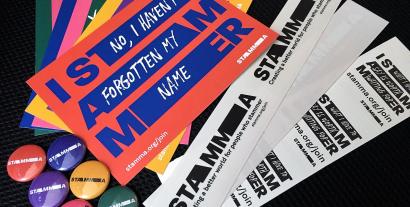
Portraying stammering the right way and changing the narrative.
We want to move away from damaging portrayals of stammering and unhelpful narratives of 'overcoming' it.
Here's how you can help us do that.
Portrayals
For many years, stammering has been used either for comic effect or to portray people with character flaws or physical inadequacies.
This stereotyping is damaging and wrong, and has real-world consequences for people who stammer. It results in them being looked down upon, mocked, bullied or pitied. From a young age, these negative reactions can affect someone's chances in life, not to mention their self-confidence and mental health.
We want an end to the use of the words 'stammering' and 'stuttering' as shorthand for failure or poor performance. Stammering is simply how some people talk. It is their natural, authentic voice.
People who stammer can be memorable, compassionate and thoughtful, often brilliant with words and fantastic communicators. What would the world be like without Lewis Carroll, Somerset Maugham, Samuel L. Jackson, Carly Simon and Emily Blunt? All people who stammer.
We aren't nervous or inadequate. Our voices should be heard and valued.
Changing the 'overcoming' narrative
It can be tempting to provide a narrative about how someone has 'overcome' their stammer. But stories like this can be unhelpful for these reasons:
- They can mislead the viewer/reader into thinking that stammering can be 'cured'. There is no cure for stammering. While it can reduce dramatically for some and others can control their stammer, this is not the case for everyone.
- The overcoming narrative can suggest that anyone who hasn't 'overcome' their stammer is a failure.
We want the media to help us ensure these voices are heard. Not in the context of how someone has 'overcome' a stammer, was defeated by it, or how they cured it. But as part of the rich pattern of accents and voices that make up all content.
Discussion Points
A less frequently discussed angle around stammering is around the barriers people face. For instance:
- In a 2025 survey, STAMMA found that 65% of recent calls made by people who stammer to a business or organisation went badly. They were hung up on, laughed at, or got stuck in voice recognition systems when they stammered.
- One mother explained that her daughter never spoke at school because she stammered. Teachers didn't see it as a problem, as she was a bright kid who got good grades. What they didn't realise was that she had no friends and would rather walk to school in the rain than get on a bus and ask for her stop.
- Lots of people who stammer have been blocked from following the career they're interested in because they were told, early on, that being a teacher, lawyer, or nurse, would not be possible.
- Insurance companies unaware of the fact that people commonly stammer on their own name, often flag them as being deceptive. We've heard many stories where someone who stammers has been perceived as lying and lost access to their bank account, or been refused medication when collecting their prescription from the pharmacy.
- Many organisations have flags in place for a range of differences or vulnerabilities. But there's rarely an opt-in flag for speech disabilities or differences, so the group remains largely 'unseen'. Consequently, people who stammer may give up on a phone call, or fail an interview or exam. They might not get that mortgage, claim that insurance or book that appointment – because they get hung up on or aren't believed. Or they're misjudged on their intelligence or personality.
If you would like to talk about this, email us at hello@stamma.org