Elizabeth Bowen - A Voice Often Heard
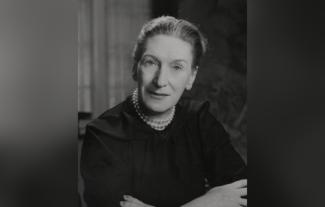
Alexander Reid got in touch to share the story of author Elizabeth Bowen (1899-1973), who stammered and whose novels and short stories led to her being nominated for a Nobel Prize in Literature.
In late 2010, not long before the following year's royal wedding, audiences flocked to see a new movie about a member of the House of Windsor struggling with the demands of his public role and the need to give speeches while coping with a stammer. Popular with critics and a box-office hit, The King's Speech swept the Academy Awards, winning Best Picture, Best Director and Best Actor for Colin Firth's portrayal of George VI. That year another tribute to a famous person with a stammer was released, albeit to much less fanfare.
The book was Listening In: Broadcasts, Speeches, and Interviews, and the writer being celebrated was Elizabeth Bowen.
An internationally popular novelist known for critically acclaimed works such as The House in Paris, The Death of the Heart and The Heat of the Day, Bowen was also a highly active broadcaster from the 1940s to her death in 1973, creating radio plays and often participating in panels and interviews to discuss books and writing. A dedicated public lecturer, she criss-crossed the United States and served as a visiting lecturer in several colleges. She also undertook official lecture tours for the British Council in Czechoslovakia, Austria and Hungary in the post-war years, with her trip to Prague being just before the 1948 coup d'état unfolded, of which she would memorably write for Vogue magazine.
To those who tuned in to her radio appearances or attended her public lectures, the great difference between Bowen and her contemporaries was the presence of her stammer.
Though more fortunate than many of her fellow countrymen and women, her early life was also not without its fair share of trauma. Her father, the owner of Bowen's Court, an Anglo-Irish estate in County Cork, had a breakdown, resulting in his wife relocating with their daughter across the water to Kent while he recovered. It was thought his breakdown later attributed to Elizabeth starting to stammer, which she never lost. The following years would see the death of her mother and life changing completely with the First World War, with years of unrest on the island of Ireland eventually resulting in partition, civil war, and the burning down of several neighbouring big houses. Her family estate survived, and Bowen became its sole female owner before selling it in 1959.
Given her vast output, there have been great efforts in recent years to secure and collect Bowen's essays, reviews, interviews and broadcasts; many were forgotten and not even included in her official bibliography. Listening In, the collection edited by McGill University's Professor Allan Hepburn, is well worth the read, as it is to listen to the available broadcasts of Bowen. Today, while many appear unavailable, one can hear her discussing ways authors can create characterisation in a 1956 clip from the BBC archive: 'Elizabeth Bowen on creating characters'.
In the United States, recordings exist of her well-attended lectures in the 1950s at New York's 92nd Street Y, 'The Poetic Element in Fiction' and 'The Problems of Contemporary Literature'. Her stammer is occasionally evident, but she had her methods for managing it. She never loses her nerve or train of thought, even when faced with a large audience.
In its extensive introduction and background notes, Listening In provides insights regarding the efforts producers, interviewers, editors and transcribers made to accommodate her stammer. Listeners' views are also included: a panel surveyed results in a poor rating, with one commenting that her so-called 'speech defects', combined with her formal, class-heavy accent, made for 'painful listening'. Though she remained an active broadcaster, there were undoubtedly producers in television and radio who hesitated about engaging her, thus being denied the chance to engage with potential readers.
Still, Bowen was not deterred, and rarely turned down an opportunity to speak. One of her very last appearances before her death resulting from lung cancer in 1973 was in A Night's Darkness, A Day's Sail, a 1970 television documentary about the life of Virginia Woolf (which you can watch on YouTube, with her first appearance at 8m 12s). One of the more surprising aspects is her focus on the great humour of her friend, whom she claims had a 'hooting' laugh, quite revealing as laughter, given the turbulence of Woolf's life and eventual suicide, is not something one generally associates with the author of Mrs Dalloway, and yet Bowen happily tells us otherwise!
While her manner of speaking was not to everyone's taste, Bowen never allowed anything to get in the way of her career or deny her the chance of expressing what she wanted and needed to say. She was not embarrassed nor anything but honest about her stammer — quite remarkable given the prejudices and attitudes of much of the era she was active in, something, even in these more understanding times, it would be advisable not to forget.
Would you like to contribute an article? See how you can Submit Something For The Site.
References
- People, Places, Things: Essays by Elizabeth Bowen (2008), Edited by Allan Hepburn.
- Listening In: Broadcasts, Speeches, and Interviews by Elizabeth Bowen (2010), edited by Allan Hepburn.
- The Weight of a World of Feeling: Reviews and Essays by Elizabeth Bowen (2016), edited by Allan Hepburn.
More
Read about more notable writers on our list of Influential People Who Stammer.
Read book reviews.
See all the ways you can Get Involved with STAMMA.
Related Links


Become a member
It's free
Join the movement to change how people understand and react to stammering.
Campaign. Fundraise. Connect. Meet. Vote. Talk.