Play review: The Presentation
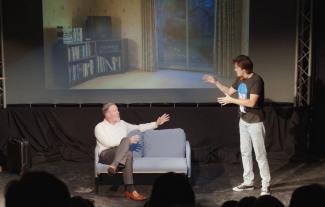
Speech & Language Therapist Katherine Brown reviews the play The Presentation, which had a limited run at the Barn Studio Theatre in Portsmouth earlier this month.
The Presentation is an autobiographical play by Roger Goldsmith with stammering as its central theme. It tells the story of Tom, a fifty-something-year-old, and Billy, his seventeen-year-old son. Set in 1985, the play follows Tom when he loses his job because of his stammer. The fallout is turbulent, and the plot follows the complexities and highs and lows of the subsequent months as Tom comes to terms with what has happened and moves on.
Early in the performance, the audience is given a sharp insight into what it is like for Tom to stammer. He stands centre stage in a spotlight, darkness surrounding him, giving a work presentation. Tom stammers as he talks and is clearly distressed — his expression is strained and his body tense, and in the background the sound of a drum mimics his heartbeat, quickening as the presentation advances. It becomes apparent that this is the presentation that lost Tom his job, not because of the information he gave, or because he was unprepared, but because of his stammer.
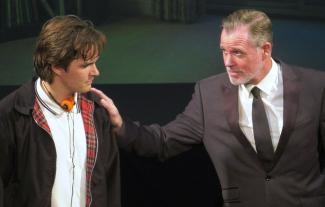
Soliloquies throughout the play give a further appreciation of how Tom’s stammer impacts the characters. Tom explains how his stammer can manifest and talks about being bullied at school. And when he loses his job, the audience watch as he becomes short tempered, falls behind on domestic chores and shrinks socially. On the inside, Tom feels inadequate, and has a heartbreakingly flat acceptance of being sacked. In contrast, his son Billy’s stance is utter shock at the gross unfairness of his father’s treatment.
The portrayal of a person with a stammer, and the stammer itself, is carefully considered by Paul Andrew Goldsmith (no relation), who plays Tom. He has clearly spent time gaining an understanding of what it is like to have a stammer, both physically and mentally, and uses this to give a sensitive portrayal of the main character, connecting, crucially, with the audience. Finn O’Toole plays Billy, his representation of a son witnessing the unfair treatment of his father is honest and animated, framed by the innocence of a boy’s perspective. O’Toole provides a welcome light-hearted element to the play and gives Billy youth and energy to be horrified and hungry for change.
The language is on occasion uncomfortable but is true to its point in time. The word ‘impediment’ is used by different characters and is a strong indicator of how stammering was considered in the 1980s. Tom refers to his stammer as ‘bad’ and ‘worse’ at times, but this is personal to the character’s experience and opinion.
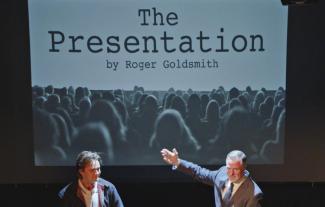
During the play, the stage adapts to different scenes and the set-up, sound and lighting work together to draw the audience into the story. The play uses music as well as fashion, news and culture from 1985 on a background screen to immerse the audience and to give a feel of the time, eg pictures of Live Aid. This example also shows the paradox that at a time where unfairness in other parts of the world was being called out, there was still devastating discrimination in this country.
The challenge of portraying passing time in a performance such as this is real — the emotions and consequences of dealing with a traumatic life event are multifaceted and the growth that follows is not immediate. The play’s time constraints give the feeling that things move more quickly than is perhaps realistic, nevertheless, the storyline and acting are compelling and give an understanding of the profound emotional hardship, and healing, that the characters experience.
Since 1985, things have changed for people who stammer — generally in society there is more acceptance of differences, and companies are required to make reasonable adjustments to support employees. However, the play highlights some similarities between then and now; workplaces still are not always fair, discrimination still does happen, and some people with a stammer still do carry shame, guilt and fear.
The Presentation is a powerful show, it is dark and light, harsh and tender, a story of adversity and survival. It is also a very important story — forty years on, though things are moving in the right direction, we still need the grit of the Toms and the energy of the Billys to call things out and make change happen, and this play shows that positive change for stammering has happened, can happen, and will happen in the future.
Thank you to Katherine for reviewing this play for STAMMA.
If The Presentation gets another run, we'll share details with our members. Not a member? Sign up to STAMMA for free so that you won’t miss our notifications.
More
Related Links


Become a member
It's free
Join the movement to change how people understand and react to stammering.
Campaign. Fundraise. Connect. Meet. Vote. Talk.